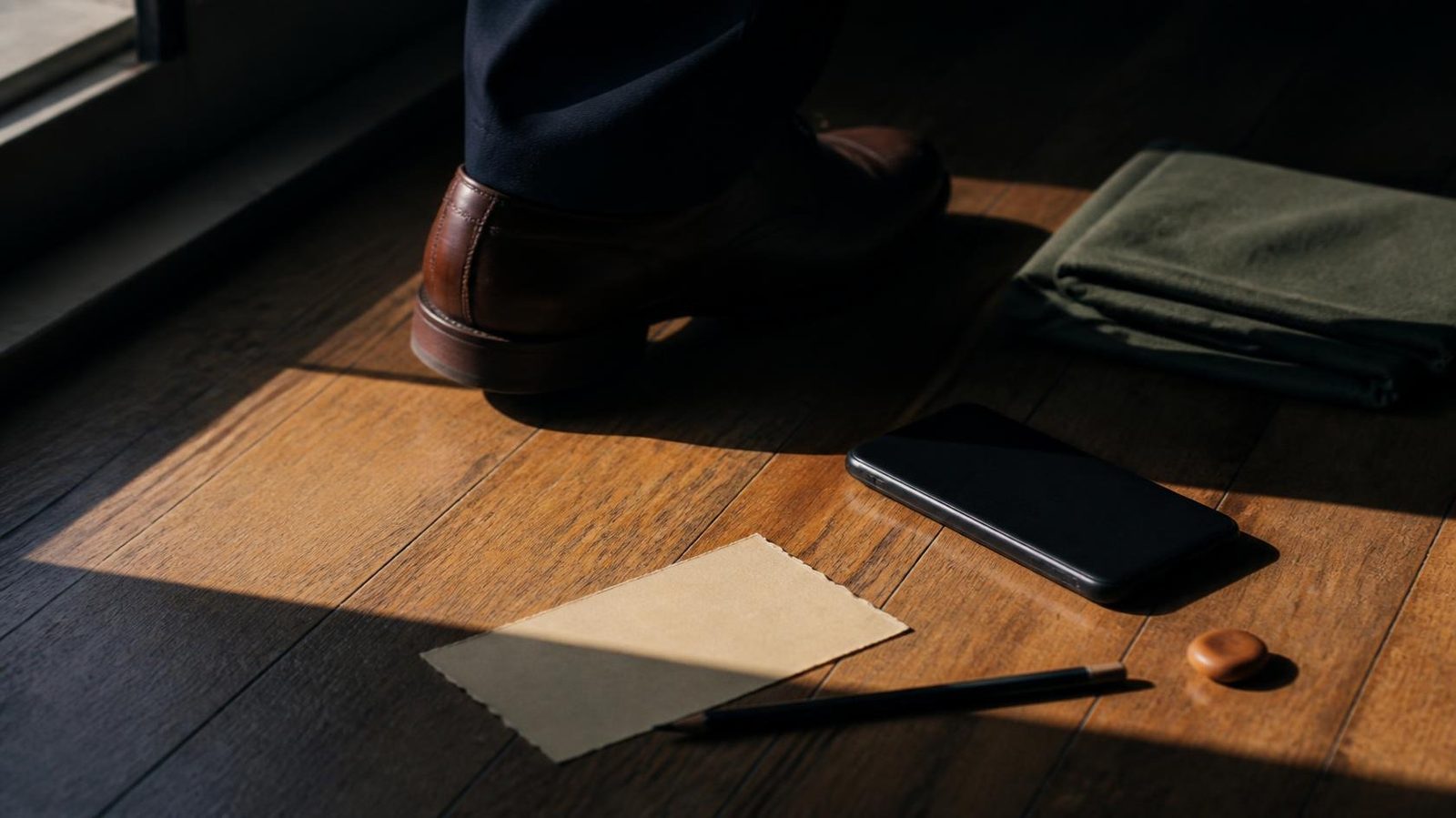
Take one real step on a real floor, record it in a single take with a recorder you already have, and listen closely enough to find one thing to fix next time.
This is the one-real-take slice: one shoe, one floor, one step, and one careful listen, with no music, no code, no audio middleware, no editing, and no effects. When you have a single file of your own footstep and one written note about what is wrong with it, you are finished.
You will not get a perfect footstep today. That is not the goal. The goal is to hear what your room, your recorder, and your floor do to a sound, because every recording you make later will run into the same three things.
What you need
- A recorder. A phone voice memo app is enough. Any handheld recorder or computer microphone also works.
- A pair of headphones. Closed headphones that cover your ears work best, but earbuds are fine.
- One pair of shoes with a hard sole.
- One hard floor you can stand on: wood, tile, concrete, or a flat stone step.
- A pen and a scrap of paper.
That is the whole kit. You are not buying anything for this.
Step 1: Pick the floor and the shoe
Walk around your home and tap your heel on a few surfaces. Listen for one that gives a short, clear knock instead of a dull thud.
A hallway with a wooden floor, a kitchen with tile, or a garage with concrete are all good choices. Carpet swallows the sound, so skip it for now.
Put on your hard-soled shoes. Sneakers with soft rubber soles make a quieter, squishier step that is harder to hear clearly on a first try.
Choose one floor and one shoe and stick with them. Changing either halfway through means you are learning about two sounds instead of one.
Step 2: Quiet the room
Stand where you plan to step and listen for ten seconds with your eyes closed. Notice anything that hums, ticks, or whooshes.
Turn off what you can. Fans, a running dishwasher, a TV in the next room, and a buzzing light are common sources. Close the window if traffic or wind is coming in.
Put your phone on do not disturb, even if you are recording with something else. A notification chime in the middle of your take ruins it.
You will not get a silent room, and you do not need one. You only need the step to be the loudest thing in the recording.
Step 3: Place the recorder
Set the recorder on the floor near where your foot will land. Point its microphone toward that spot. On a phone, the microphone is usually a small hole along the bottom edge. Check your phone’s own help pages if you are not sure where yours is.
Keep it close, but not so close that you might kick it. A forearm’s length away from your landing spot is a reasonable place to start.
Do not hold the recorder in your hand. Your fingers rubbing the case will end up in the recording, and the step will sound far away.
Step 4: Record one take
This is the only take you will make today, so do it slowly.
- Stand still one stride back from your landing spot.
- Start the recorder.
- Stay still and silent for a few seconds. That quiet stretch matters. It is a sample of your room with no step in it.
- Take one normal step forward onto the landing spot. Do not stomp. Walk the way a character in your game would walk.
- Freeze. Do not shift your weight or bring your other foot forward.
- Stay still for a few more seconds while the sound dies away.
- Stop the recorder.
Rename the file step_01 so you can find it again. Most voice memo apps let you rename a recording. If yours does not, write down the time you recorded it.
Resist the urge to record a second one right now. Listening comes first.
Step 5: Listen on headphones
Sit down somewhere comfortable and put on your headphones. Set the volume low at first, then raise it until the step is clearly audible but not uncomfortable.
Play the file three times. Each time, listen for something different.
First listen: the quiet part. Ignore the step. Pay attention to the seconds before it. What do you hear when nothing is happening? A hiss, a hum, a distant car, the fridge?
Second listen: the hit. Focus on the moment your foot lands. Does it sound clean, or does it crackle, buzz, or sound harsh and flattened?
Third listen: the shape. Follow the step from start to finish. Is it one sound, or do you hear it in parts?
Speakers hide a lot of these details. Headphones put the sound right against your ears, which is why this step uses them.
Step 6: Notice one problem
Every first recording has problems. Pick the one that bothers you most and write it down. Here are the three most common.
Too much room noise. On your first listen, the quiet part was not very quiet. A steady hiss or hum sits under everything, and the step seems to float on top of it. Next time, move the recorder closer to the step or turn off one more noise source.
The peak clips. On your second listen, the moment of impact sounded crunchy or distorted, like a speaker being pushed too hard. That usually means the sound was too loud for the recorder at that distance. If your app shows a waveform, the loudest part may look chopped flat at the top. Next time, move the recorder a little farther away or step a little softer.
The step is two sounds. On your third listen, you heard the heel land and then the toe slap down a moment later. Or you heard the shoe scuff and then a floorboard creak. Two sounds are not always bad, since many real steps have both. But if it sounds messy instead of natural, try a different shoe or a firmer, flatter step next time.
Write your one problem on the paper. Use plain words. “Fridge hum under everything” is a better note than “noise issues.”
If you hear more than one problem, pick one anyway. You can only fix one thing at a time if you want to know what each fix did.
Step 7: Leave it alone
Do not open an editor. Do not trim the file, raise its volume, or run it through a noise filter. Those are useful tools, but using them now hides what the recording sounds like as it was captured.
Keep step_01 exactly as it is. It is your reference. When you record step_02 next time, after fixing the one problem you wrote down, you will play the two files back to back and hear the difference for yourself.
Stop here
You chose a floor and a shoe, quieted a room, placed a recorder, captured one step in one take, and listened on headphones with a plan. You also found a problem and named it in plain words.
That listening habit matters more than the file. Tomorrow, read your note, change the one thing it tells you to change, record one more step, and compare.